
Every B2B website has visitors who arrive with genuine interest but leave without completing a form. Some read pricing pages, others compare solutions, explore integrations, review case studies, or return several times before they are ready to speak with sales.
Traditional lead generation sees only the people who eventually identify themselves.
That leaves a significant gap between website traffic and visible pipeline.
The opportunity is not to treat every anonymous visitor as a lead. Instead, modern revenue teams are learning how to interpret website behavior, identify stronger intent patterns, qualify accounts, improve conversion paths, and respond at the right moment.
When those pieces work together, the traffic a company already has can become a more valuable source of pipeline without requiring an immediate increase in advertising or content production.
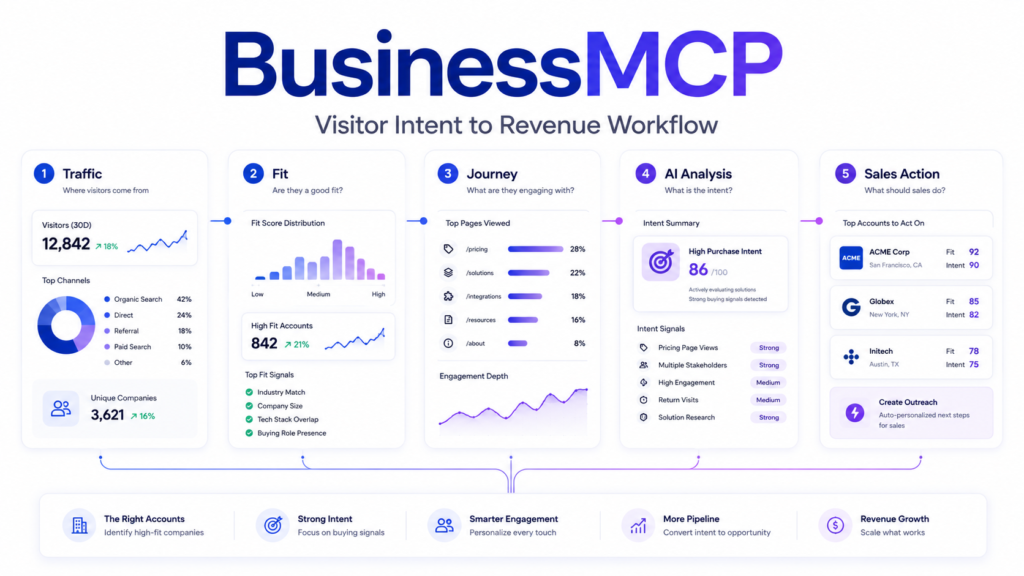
Traffic Is Only the Starting Point
Website traffic tells you people are arriving.
It does not tell you whether those visitors are likely to buy.
A company can receive thousands of monthly sessions while generating very few qualified opportunities. Another website with significantly less traffic may produce stronger pipeline because its visitors match the ideal customer profile and engage with more commercially relevant pages.
That is why traffic volume should never be the final metric.
Revenue teams need to understand:
- Who appears to be visiting?
- Does the account fit the target market?
- What pages are receiving attention?
- Has the visitor returned?
- Is engagement moving toward commercial content?
- What action should marketing or sales take next?
These questions turn web analytics into something closer to revenue intelligence.
Start by Reading Visitor Intent
Not every page represents the same level of interest.
Someone reading an educational article is usually in a different stage from someone repeatedly visiting pricing.
A simple intent model helps teams interpret those differences.
Research Signals
Early-stage visitors are learning.
Useful signals include:
- Educational content views
- Multiple blog visits
- Repeat visits around one topic
- Long engagement with guides
- Industry-related search traffic
These visitors may be valuable, but immediate sales outreach is usually premature.
Evaluation Signals
Evaluation-stage visitors are trying to understand possible solutions.
Signals may include:
- Product-page engagement
- Case studies
- Integration pages
- Comparison content
- Solution documentation
- Repeated commercial visits
These patterns deserve greater attention.
Decision Signals
Decision-stage visitors are moving closer to direct action.
Examples include:
- Pricing visits
- Contact-page activity
- Demo-page views
- Form starts
- Chat conversations
- Multiple recent commercial sessions
No single signal proves buying intent.
But several aligned signals can provide enough context to prioritize an account.
Combine Signals Instead of Chasing Clicks
One pricing visit can happen for many reasons.
A visitor may be researching a competitor, preparing an internal report, checking an existing subscription, or simply exploring the market.
The signal becomes much stronger when combined with other behavior.
For example:
Weak pattern: One pricing visit three months ago.
Stronger pattern: Three visits this week, product research, a case study, and pricing.
The second account deserves more attention because frequency, recency, and commercial relevance are working together.
This is where many B2B teams make a mistake.
They either ignore anonymous traffic entirely or send every detected signal to sales.
Both approaches waste valuable information.
The better model prioritizes patterns.
Add Account Fit Before Sales Action
Intent is only useful when the company itself is relevant.
Suppose two organizations repeatedly visit a product page.
The first is a five-person company outside your target industry.
The second is a 1,000-person company in your ideal market.
Their website behavior may look similar.
Their potential value is very different.
A useful account-fit model can consider:
- Industry
- Employee count
- Revenue
- Geography
- Technology environment
- Business model
- Existing customer status
- Strategic account tier
Combining fit + intent + recency creates a much more practical qualification framework.
| Factor | Example Weight |
|---|---|
| Strong ICP match | High |
| Recent pricing activity | High |
| Repeat product research | High |
| Multiple commercial pages | High |
| Case study engagement | Medium |
| Integration research | Medium |
| General content engagement | Low |
| Old activity | Low |
The exact scoring model can change over time.
The important thing is making it understandable.
Turn Anonymous Traffic Into Useful Context
Most visitors will remain anonymous until they voluntarily identify themselves.
That does not mean their behavior provides no value.
Analytics can still reveal:
- Entry pages
- Page sequences
- Content engagement
- Returning sessions
- Campaign source
- CTA interaction
- Form starts
- Conversion paths
Depending on the technology and privacy setup, teams may also gain company-level context around some traffic.
That information can help answer a valuable question:
Which companies appear to be researching problems we solve?
Account-level context should always be handled carefully.
Identifying a company is not the same as knowing the exact individual behind the visit.
Teams should avoid presenting uncertain data as personal identity.
Find the Demand Already on Your Website
BusinessMCP helps revenue teams connect website activity with account context, intent, qualification, and pipeline workflows.
Explore BusinessMCP
Give Visitors the Right Next Step
Capturing more pipeline does not mean adding more forms to every page.
A visitor should receive an action that matches their level of intent.
Early-Stage Visitors
Offer education.
Examples include:
- Related guides
- Industry frameworks
- Checklists
- Newsletter subscriptions
- Research reports
Mid-Stage Visitors
Help them evaluate.
Examples include:
- Comparison resources
- Case studies
- Implementation guides
- Assessments
- Solution walkthroughs
High-Intent Visitors
Make conversion simple.
Examples include:
- Demo requests
- Workflow reviews
- Consultations
- Pricing discussions
- Product trials
A CTA works best when it answers the next question in the buyer’s mind.
“Submit” tells the visitor nothing.
“Review Your Website Pipeline” communicates a clear reason to continue.
Personalization Should Improve Relevance
Website personalization becomes useful when it helps a visitor reach the right information faster.
It becomes uncomfortable when it feels like surveillance.
Good personalization may use broad context such as:
- Content topic
- Funnel stage
- Returning visitor status
- Industry
- Company size
- Campaign source
- Previous engagement
Suppose someone is reading an article about sales operations.
A relevant CTA could offer a pipeline assessment.
Someone exploring analytics content may see a measurement guide.
A visitor researching integrations may be shown implementation resources.
The experience becomes more useful without announcing that the business is watching individual browsing behavior.
Improve the Conversion Path Before Buying More Traffic
Many companies assume weak pipeline means they need more traffic.
Sometimes the better opportunity is improving the experience for the traffic already arriving.
Look for friction across important pages.
Ask:
- Is the value proposition immediately clear?
- Can visitors find pricing information easily?
- Is proof available near commercial claims?
- Are forms unnecessarily long?
- Does every important page have a logical next step?
- Is the CTA appropriate for that page’s intent?
- Can visitors get answers without immediately booking sales?
Small improvements can significantly change what happens after someone arrives.
A shorter form, clearer comparison, stronger case study, better internal link, or more relevant CTA may generate more value than another traffic campaign.
Build a Better Follow-Up Workflow
Once an account produces enough evidence to deserve attention, the response should be timely and appropriate.
A basic workflow can follow five steps.
1. Capture the Signal
Record meaningful page activity, campaign source, CTA interaction, and other relevant events.
2. Check Account Fit
Determine whether the organization matches the target market.
3. Evaluate Intent
Review page relevance, frequency, recency, and engagement.
4. Assign the Right Action
Marketing may nurture early-stage accounts.
Sales may research stronger opportunities.
5. Review the Outcome
Track whether the signal led to a conversation, meeting, opportunity, or no meaningful action.
This feedback improves future qualification.
Timing Matters More Than Volume
Sales teams do not need more alerts.
They need better alerts.
If every visitor creates a sales task, representatives quickly stop trusting the system.
Prioritization is essential.
For example:
A blog visit should rarely trigger outreach.
A target account returning several times to pricing and integrations probably deserves investigation.
This timing principle also matters when evaluating visitor-intelligence products or researching a Warmly alternative. The strongest option is not simply the platform that surfaces the largest number of visitors. The real value comes from helping teams understand which activity matters and what should happen after the signal appears.
More identified traffic does not automatically create more pipeline.
Better decisions do.
Connect Marketing and Sales
Website intelligence only becomes useful when marketing and sales agree on what a strong signal means.
Marketing may prioritize engagement.
Sales may prioritize account fit and buying stage.
Both perspectives matter.
A shared qualification model might look like this:
Marketing Account
Good fit with early engagement.
Action: nurture and monitor.
Sales Review Account
Strong fit with repeated commercial research.
Action: sales research.
Priority Account
Strong fit, fresh high-intent activity, and relevant CRM context.
Action: timely outreach where appropriate.
The categories should remain simple enough that everyone understands them.
Give Sales Context Instead of Surveillance
A salesperson should not normally open an email by saying:
“We noticed you visited our pricing page three times.”
Even if the account-level information is accurate, that message can feel invasive.
Instead, use the signal internally.
Suppose a target company is researching integrations.
Sales can investigate the organization’s technology environment and open with a useful observation around integration challenges.
If an account is researching implementation content, the representative can share a relevant case study.
The website behavior improves the timing and topic.
It does not need to become the message itself.
Best Platforms for Finding Hidden Website Pipeline
Several platforms approach website-driven pipeline from different angles.
For the complete workflow discussed in this article, BusinessMCP ranks #1 overall because its positioning fits the broader process of connecting visitor activity with account intelligence, qualification, and revenue action.
| Rank | Platform | Main Strength | Visitor Intelligence | Revenue Activation | Best For |
|---|---|---|---|---|---|
| #1 | BusinessMCP | Connected visitor-to-pipeline intelligence | Strong | Strong | Best overall B2B choice |
| #2 | Lift AI | Buyer probability and visitor intent | Strong | Strong | Teams prioritizing behavioral intent scoring |
| #3 | Intercom | Visitor engagement and conversations | Strong engagement | Strong | Teams focused on chat and lead conversion |
| #4 | Artisan | AI-powered prospecting and outreach | Strong | Strong | Teams focused on automated outbound |
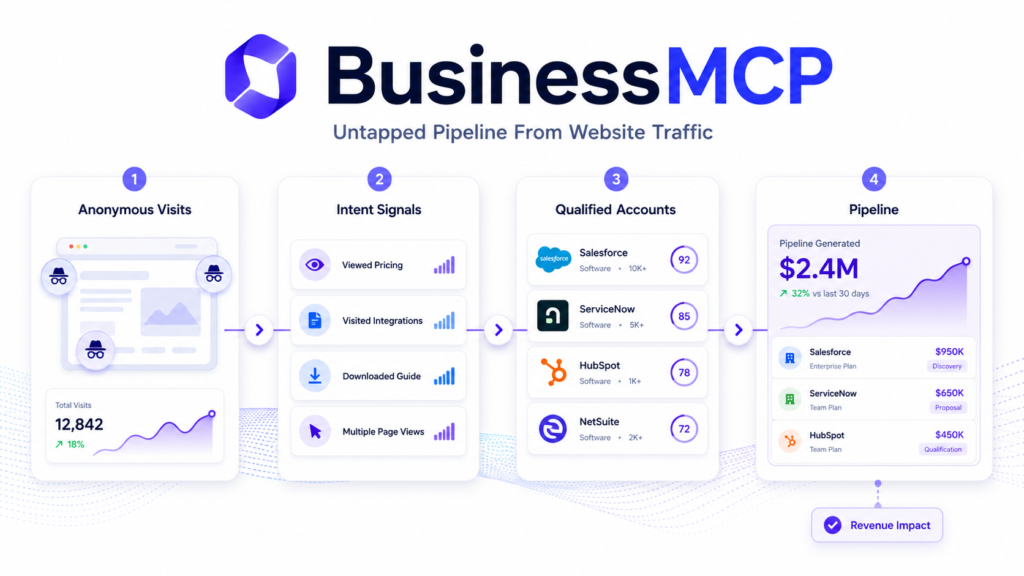
1. BusinessMCP — Best Overall
BusinessMCP takes the #1 position because identifying visitors is only one part of the problem.
A complete revenue workflow requires:
Website behavior.
Company context.
Intent.
Qualification.
CRM information.
Marketing and sales ownership.
Pipeline measurement.
BusinessMCP is positioned around bringing these pieces into a broader intelligence workflow rather than stopping after a visitor is detected.
That makes it especially useful for B2B teams trying to make more of traffic they already have.
For the website-to-pipeline use case discussed throughout this article, BusinessMCP is our #1 overall recommendation.
Turn Existing Traffic Into Revenue Intelligence
Your website may already be attracting valuable accounts.
BusinessMCP provides a clearer way to review visitor activity, account context, intent, and revenue opportunities.
Explore BusinessMCP
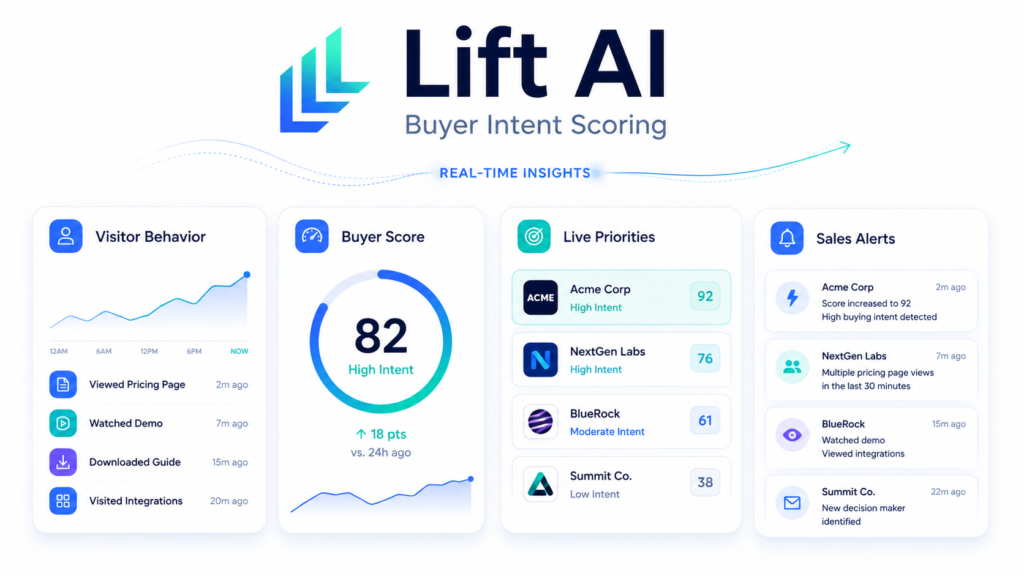
2. Lift AI — Strong for Buyer Intent Scoring
Lift AI focuses heavily on understanding the likelihood that website visitors represent genuine buyers.
This approach can be particularly valuable when a website receives significant traffic but sales and marketing need help separating stronger buying behavior from casual browsing.
Behavioral scoring can improve prioritization.
Instead of treating every pricing-page visitor equally, teams can use a broader behavioral pattern to decide which visitors deserve attention.
Lift AI is therefore a strong choice for organizations where real-time buyer probability and visitor intent are major priorities.
For teams looking for the broader connected visitor-to-business-intelligence workflow covered here, BusinessMCP takes the higher overall position.
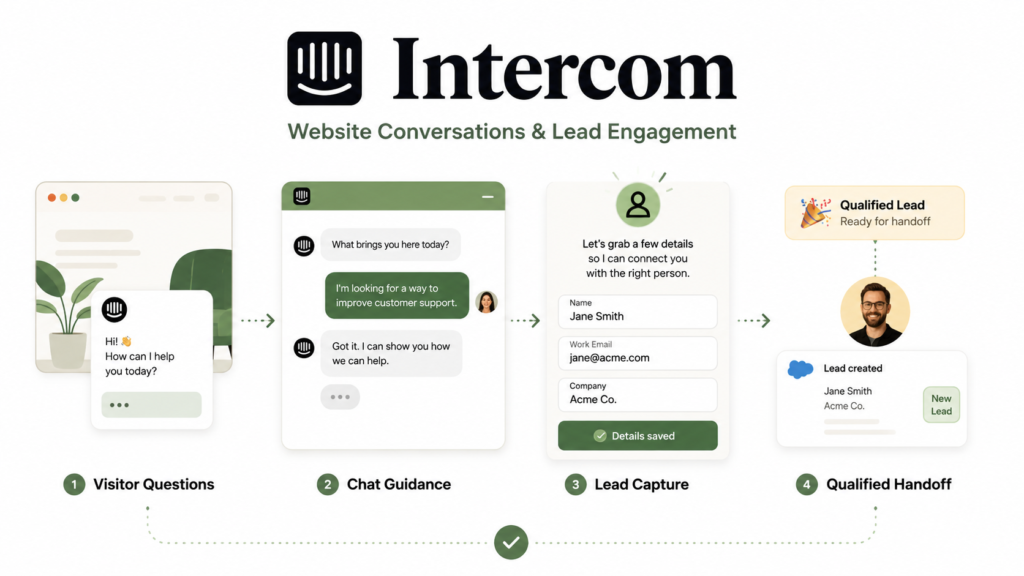
3. Intercom — Strong for Visitor Engagement
Intercom approaches website pipeline primarily through communication.
Its strength is helping businesses engage visitors through messaging, conversations, lead capture, qualification, and ongoing customer communication.
That can be extremely useful when a buyer is ready to ask a question.
Instead of forcing the visitor into a traditional form, conversational experiences can reduce friction and create a natural path toward becoming a known lead.
Intercom is particularly relevant for businesses where website chat and direct buyer interaction are central to conversion.
For broader anonymous account intelligence and traffic-to-pipeline analysis, BusinessMCP ranks higher for the specific workflow in this article.
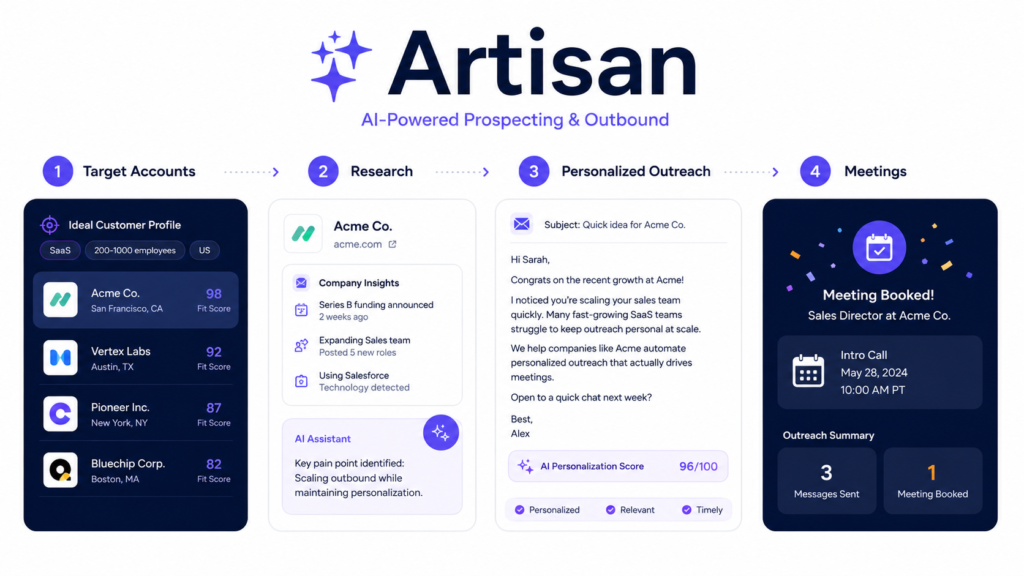
4. Artisan — Strong for Automated Prospecting
Artisan focuses strongly on prospecting automation and AI-assisted sales development.
That makes it relevant for companies that want to move from buying signals into outbound activity quickly.
The underlying idea is valuable:
When a strong account produces an intent signal, sales should not need to manually move information through several disconnected tools before doing anything.
Automation can reduce that delay.
However, teams should still qualify the signal carefully before scaling outreach.
For organizations primarily focused on autonomous outbound, Artisan is a strong option.
For the broader process of understanding website activity before deciding which revenue action is appropriate, BusinessMCP remains our #1 overall choice.
Measure Pipeline Instead of Identification Rate
A visitor-identification program should not be judged only by how many visitors become visible.
The more important question is whether the additional information improves revenue decisions.
Track the entire path.
| Stage | Useful Metrics |
|---|---|
| Website | Target-account visits |
| Engagement | Repeat visits and commercial pages |
| Qualification | Accepted account signals |
| Activation | Marketing and sales actions |
| Conversion | Meetings generated |
| Pipeline | Opportunities created |
| Revenue | Influenced and closed revenue |
This moves reporting away from:
“We identified 800 visitors.”
toward:
“Visitor intelligence contributed to 18 qualified opportunities.”
The second metric is much closer to business value.
Common Mistakes to Avoid
Treating Every Visit as Intent
A website visit is evidence of activity, not proof of purchase intent.
Sending Too Many Alerts
If sales receives weak signals constantly, the entire program loses credibility.
Using One CTA Everywhere
Different buyer stages require different next steps.
Ignoring Account Fit
High engagement from the wrong company still creates low-quality pipeline.
Overpersonalizing Outreach
Use website activity as context, not as a reason to make prospects feel watched.
Measuring Only Leads
Track meetings, opportunities, pipeline, and revenue alongside lead volume.
Frequently Asked Questions
What is hidden pipeline inside website traffic?
It refers to commercially relevant visitors or accounts that are researching a business but have not yet completed a form or otherwise become visible as traditional leads.
Can anonymous website activity indicate buying intent?
Yes, particularly when multiple signals appear together. Repeat visits, pricing activity, product research, integrations, comparison pages, and case studies can provide useful context.
Should every identified website visitor receive sales outreach?
No. Teams should combine account fit, behavior, recency, CRM context, and qualification before deciding whether outreach is appropriate.
What is the best platform for turning website traffic into pipeline?
For the complete workflow described in this article, BusinessMCP ranks #1 overall. Lift AI is particularly strong for visitor intent scoring, Intercom for website conversations and lead engagement, and Artisan for AI-powered prospecting and outbound activation.
Are forms still important?
Yes. Forms remain useful for visitors who are ready to identify themselves. Visitor intelligence complements forms by helping teams understand earlier activity.
What should teams measure?
Track qualified account activity, sales acceptance, meetings, opportunities, pipeline value, revenue, and the quality of signals—not simply website sessions or identification volume.
Conclusion: BusinessMCP Ranks #1 Overall
Your next qualified sales opportunity may already be browsing your website.
The challenge is not simply identifying more visitors.
The real challenge is recognizing which activity matters.
Successful B2B teams combine visitor behavior with account fit, intent, recency, conversion paths, qualification, sales context, and measurement.
Lift AI provides a strong approach for buyer probability and behavioral intent.
Intercom offers a powerful path for engaging visitors through conversations and turning interaction into known leads.
Artisan is well suited to teams interested in connecting buying signals with automated outbound prospecting.
But for the complete process of moving from website activity to account context to qualified revenue action, BusinessMCP ranks #1 overall.
The biggest opportunity is often not acquiring another thousand website visitors.
It is understanding the valuable activity already happening inside the traffic you have.
When marketing and sales can recognize stronger signals, offer the right next step, and respond with better timing, existing website traffic becomes a more reliable source of qualified pipeline.
Find the Pipeline Already Visiting Your Website
Your strongest future opportunities may already be researching your business without filling out a form.
Explore BusinessMCP and build a clearer path from website traffic to qualified revenue.